Yes, we know it's been quite a while since the previous Episode was published, but rest assured that the New House Blog is still a going concern. These past seven months or so, have apparently just been too full of life and business for me to take time to publish any new Episodes. Among the things we accomplished are included: obtaining (legally) a kayak and life vest for exploring local waterways; planting some new cactus; beginning a new battle of the stump; travelling to Jefferson, Texas (the Bigfoot Capitol of Texas); travelling for work to Houston; travelling to the Bay Area for a few days to visit family and work at the Parents' House one last time; observing live animals that are not native to this continent; feeding hungry cats; playing music; chopping fire wood; saving energy; and a lot more mundane stuff that you are probably not interested in reading about. We will discuss most of the above in this Episode, but we probably won't cover all of it (which is, I'm sure, a relief to hear).
More New Replacement Plants
You will recall that the previous Episode discussed the replacement and restoration of several plants that did not survive the freakish, frigid, February frostiness; and we have since replaced several more plants - some of which were, indeed, victims of the vicious weather.

This plant, next to the Spanish Dagger (Yucca Gloriosa), may be an Agathosma Collina, but I'm not completely sure. And it really doesn't matter any more, because it seems to have perished, despite not experiencing any freezing temperatures. It was planted as a replacement for something else, and for several months it thrived (throve?), but then it just died without warning.
These two bushes, of unknown name, were replaced because some of us found them to be rather ugly. And the other of us does not need a whole lot of persuading (sometimes) when it comes to planting new plants.
We replaced them with these two Silver Buttonwood bushes (Conocarpus Erectus). So far they are thriving, and they have grown significantly larger.
This family of Silver Torch Cactus (Cleistocactus Strausii) replaces the Grey Ghost Organ Pipe Cactus (Stenocereus Pruinosus) that succumbed to the snow last winter. We had a tall, single Silver Torch at our California House, and it was thrivening (thriving? throving??) when we escaped California.
This Mini Cholla (Cylindropuntia) is an addition, not a replacement. I was at a local plant seller, and I saw this cute little guy, and I knew we had some vacant pots (and the label says it is great for pots), so I acquired it (legally). One advantage of potting it is that we can bring it inside the garage if the temperatures get too low.
This Rainbow Elephant Bush (Portulacaria Afra 'Variegata') replaces the Echeveria 'Dick's Pink' (Echeveria 'Dick's Pink') that froze last winter. We loves our Elephant Bushes, and we were looking for an excuse to get one (and for a place to put it out of the deers' reach).
We had to try again with the Firesticks (Euphorbia Tirucalli). So far, we have lost three of them at our Texas House - two due to the frosty freeze, and one due, at least in part, to grasshoppers (we think). If we can keep the grasshoppers away this one might survive.
The Fire Inside
Speaking of fire sticks, we have been preparing for the forecasted frigid February by gathering and chopping wood.
Behold the main wood pile (background) and the auxiliary wood pile (foreground left). This is our main wood splitting and stacking area. From here it goes to the garage, then to the front porch, then inside the house, then into the fireplace. We placed the main wood pile here because it is a nice, open, sunny area - good for wood drying - and because of the layers of small rocks that provide separation between the wood and the dirt.
Behold the newest team member. Meet Antilles, our new splitting wedge. Some might call Antilles a splitting ax or maul, but we will stick with wedge. Behind Antilles you can see the tertiary wood pile area. This area is in the shade a lot, and the wood is sitting directly on the dirt, so we move logs and branches from here to the main wood pile for processing.
Where did all of this wood come from? I can personally testify to all y'alls that all (almost all) of our fire wood is completely organic and locally grown. Mainly it comes from two sources - the elm tree that previously lived next to our driveway (and Becky's truck), which you saw removed in
this Episode; and the branches of the neighbor's tree that you saw me hack up in
this Episode. Additional fire wood was sourced from dead branches and tree limbs already extant in our yard. And in the name of full disclosure I must admit that there was a small bundle of store-bought fire wood on our porch when we bought our Texas House.
Behold our first fire in our fireplace. Our local, organic wood burns very well in a fireplace.
Farewell Parents' House
This Episode marks the final appearance of the Parents' House on the New House Blog. It happened that while I was out of town for work I had the opportunity in my schedule to fly out to the Bay Area for a few days to visit family and help my mom in and around the house. While there I completed two projects.
I remember planting this with my dad, and possibly a brother or two, way back when we first moved into this house in the late 1990's. For many years it throve, but alas, it stopped thriving at some point and died.
As you can see, it is completely dead and dried out. As such, it seemed to me to be a good idea to remove this fire hazard (California seems to be in a perpetual drought, you know) and spruce up the yard a bit.
These are the only tools used for this job, and the wood turned out to be a bit tougher than expected. No, I did not take any of this wood home for fire wood. It would have been awkward to get it through airport security and onto the plane for the flight back to Texas.
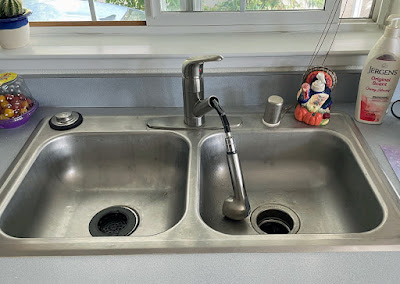
You will recall that I replaced the Parents' House's original kitchen sink faucet in
this Episode. Well, seven years of wear and tear were too much for the faucet's poor main hose, and it developed a leak right near where the hose meets the handheld sprayer part. I tried the Flex Tape fix, but the nature of the leak was such that Flex Tape was not able to completely seal it. Looking back, it seems that this leak may have been the result of a design flaw.
This shiny new faucet is the replacement for the old, leaky faucet. As you can see, it works perfectly, and there are no leaks (as of the time of install. All workmanship warrantees are void upon sale of the house).
Between the two projects above mentioned, I am sure that I added at least $0.47 in resale value to the Parents' House. I am glad to report that the house sold, and my mom was able to successfully escape from California.
Goodbye, Parents' House. It was a good collaboration, we thoroughly enjoyed your guest appearances on the New House Blog. Good luck and success with your new owners and inhabitants.
Fan-tastic
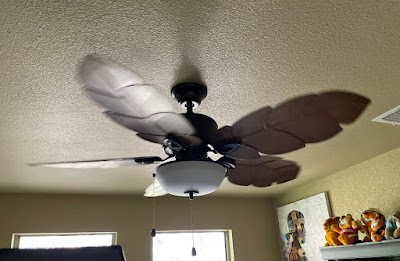
Our next project involves ceiling fans. Our Texas House has nine ceiling fans inside, and three or four outside above the back porch. Two of those internal eight were noisy to the point where we did not want to use them.
The two offending fans were located upstairs - one in my office and one in the music room. Here you can see the fan in my office in a partially disassembled state.
Here you can see both of the old, noisy fans in their fully disassembled state.
For my office we installed a slightly fancier fan, with lovely leaf-shaped blades. Sadly, we had to remove the glass light bowl due to its unexpectedly high level of opacity.
The music room received this less-fancy, but quite functional, replacement. This fan retains its glass light bowl.
Local Wildlife
Fillmore is running through the tall grass in the back yard. How did he get out there where he doesn't belong? He took advantage of a not-quite-latched front door and went exploring. When I found him he was clearly trying to get back into the house, but he couldn't quite figure out how to do so.
As you can see, we got him back into the house, and he has not slipped out since.
One reason our little cats should not go outside is snakes. You will recall that in
this Episode I encountered a venomous Texas Coral Snake (Micrurus Tener), and in the photo at right you can see a Western Diamond-backed Rattlesnake (Crotalus Atrox) - a rather small example. Fortunately, he was already dead when I found him and removed him. I used our handy pitchfork to pick him up and transport him.
On a more benign note, here is a live Rough Green Snake (Opheodrys Aestivus) - a non-venomous, friendly snake. As you can see he is showing off by slithering through a crevasse in the tree's bark.
Windows 21
So, it was on the first snowy night of last winter that I really appreciated how drafty our bedroom windows were. I was up quite late, appreciating the snowy view, and the power went out. No big deal. Our Texas House has good insulation, and we have a lot of blankets. I entered the bedroom, to go to bed, and as I looked out the window I noticed sub-freezing air wafting into our bedroom from the poorly-sealed windows.

As a temporary measure (if several months is temporary) I stuffed rags into the gaps to staunch the flow of frosty, frigid, freezing air. The rags were effective, but clearly it was time to replace these defective windows. For this job we called in the professionals. It turns out that our Texas House has about a bajillion windows, and replacing them all would cost about eleventy bajillion dollars, so we opted to replace about half of them, and replace the others down the road sometime. We did the master bedroom suite, Becky's office, and the upstairs. The new windows look a lot like the old windows, so there are no pictures of them included. So far there have been no cold drafts from the new windows.
Battle O' The Stump
I have lost track of how many tree stumps we have battled, so there is no number attached to this ongoing battle. It all started back in
this Episode, when we had our dead and rotting elm tree removed. The stump was left in the ground, and we have been battling to remove it for several months.
At first we tried a product that claimed it would help break down the wood and make it easier to break up (or burn out). We had trouble with the stuff, and it didn't seem to make a difference, so we just accepted the fact that this would be a lot of manual labour.
As you can see, the stump began coming out in large chunks.
We are making progress.
This is the current status, as of this Episode. We have dug around the core of the stump, and to the left we remove d a rotted root section. The removed chunks of stump seem to burn quite well in the fireplace.
Final Replacement Cactus
When we left off above with the replacement plants we forgot to include one last cactus. And instead of re-editing this Episode, we're going to include it right here, right now.
Meet our
Austrocephalocereus Estevesii (Siccobaccatus Estevesii), the last of the replacement cactus. It replaces the False Saguaro (Pachycereus Pringlei).
We did have a single replacement of a replacement. One of our two Dianthus (Dianthus) died, so we replaced it with a shoot from our Striped Century Plant (Agave Americana Veriegata). Said agave has put out a few new shoots, and we have potted a second shoot, in addition to planting this one.
BYA Update
There is not much to see in this Back Yard Archaeology update.
There is a crushed can, and a twisted piece of metal - both dug up from various excavation spots - and multi-colored plastic ball that presumably washed down the Wadi al Bish during a recent rain. As usual, the glove is for scale, and is not itself an artifact. The can was too damaged for us to determine its original contents. Possibly it was Mountain Dew.
Grand Finale
And we end this Episode with a Merry Christmas wish from the San Antonio Zoo. As you can see, their dinosaurs have throven (throved? thriven? thrived? thraved?) since our last visit.
Here's hoping that all y'alls thrive and prosper throughout the new
bIsh