Friday, February 26, 2016

A Word About Samoa

While the New House Blog is on its winter hiatus we thought it a good time to bring you an exciting and entertaining account of our recent (Christmas time) trip to Samoa.  Our adventures will be presented mostly in chronological order, but first a word about airports.

A Word About Airports

We flew out from San Francisco International Airport (SFO (AKA KSFO)), and of all of the large international airports I've been through, SFO is the most disappointing and the least interesting.  The international portion seems to consist mainly of long, boring walkways and a few sparse, scattered shops and mediocre cafes.  The actual gates are downstairs, relative to the walkways, and they are bland and monotonous.  If you fly out of SFO bring some books or movies, cause it's gonna be a boring wait.

Auckland International Airport (AKL (AKA NZAA)), the second and fourth airport we passed through, on the other hand, is an inviting and interesting place to wait for your flight.  The bright and colorful international lounge has several shops and restaurants, it has big windows for watching the planes, and it has large couches that are useful for sleeping on when your plane arrives at 1:30am, local time, and your next flight isn't for another ten hours.  The bookstore in the international lounge, by the way, opens at 4:00am (how do I know this?).  On our first pass through AKL we had to go all the way out to gate 16, the very farthest gate we could possibly have to go to,

Due to the twists and turns in the walkways, Gate 16 felt like it was at least a half a mile away from the main lounge area.

Another nice thing about AKL is its relaxed atmosphere.  People didn't seem to be rushing about or in a hurry to get places.  Note that even the signage is telling you to relax.

Our third airport was Faleolo International Airport (APW (AKA NSFA)), in Apia, Samoa. Upon arriving in Samoa we had only a very brief wait for our luggage, and the the trip through immigration and customs was also brief.  It may have been the quickest I've ever been let into a foreign country, so far.  It is also, by far, the smallest international airport that I have passed through.  Becky says that the international airport in Palermo, Sicily, is even smaller (and there are goats nearby).  I didn't really notice or appreciate APW's small size until we had passed through security, customs, and immigration as we commenced our return trip to the USA.  The trip through security was the quickest I've experienced in a long long time.  I didn't have to take off my belt or shoes, and the security lady even let me take my opened bottle of water through (after asking me to take a sip to prove it was really water).  Immigration and customs were also quick, and we arrived at the gate with plenty of time to kill.  And there were only two gates to choose from.  And they shared one waiting area.  And there were two snack shacks, one duty-free shop, and one other shop of some sort.  That's it folks - one waiting room with two gates, and two eating choices, two shops, and two malfunctioning tv screens.

It was good to get back onto US soil at Honolulu International Airport (HNL (AKA PHNL)), our 5th airport.  Due to a scheduling snafu with Expedia, our return trip included of a 10-hour overnight layover in Auckland, and another 9-hour overnight layover in Honolulu.  Because we are both US citizens, we got to go through the express line in immigration and customs, and we were outside of the international terminal pretty quickly.  The inside of the HNL domestic terminal is kind of inside and outside at the same time.  There is a long hallway, with plenty of shops and restaurants (all of them closed when we arrived late at night), and the ends of the hallway are open to the outside air.  There are also openings in the walls that allow in the outside air.  Sleeping at HNL is much less comfortable than sleeping at AKL.  We at first tried to sleep on the regular airport chairs, but Becky discovered a pair of massage chairs that were a little better than the typical airport chairs, but not as nice as the couches at AKL.  I don't know what time the bookstore opens at HNL, but the Burger King was open by 7am.  At HNL, due to the previously-mentioned snafu, we switched from Air New Zealand to United for our final flight back to SFO.  And that brings us to a word about airlines.

A Word About Airlines

Our first four flights were with Air New Zealand, and they quickly proved themselves to be one of my favourite airlines.  This may be, in part, due to our first-class treatment in first class on our first flight from San Francisco to Auckland.  As partial compensation for the infamous scheduling snafu, we got promoted to the first class cabin on our first flight, and let me tell ya - the first-class cabin of a Boeing 777 is a great place to be for a twelve-hour flight.  You get your own cubicle that turns into a bed, a big tv on a swing arm, a huge table that you can sit two people at, great food, great hot tea, and great service.  It's kind of like being at a fancy restaurant for 12 hours, with tv and movies.

Here we are, sharing a meal.

Another thing that sets Air New Zealand apart, in my view, is their safety video.  They have the best safety video that I've ever seen.  It's so good that you want to actually watch it.  It features beautiful people, surfing, Jeeps, swimming, the ocean, and that great New Zealand accent.

We only got first-class on the first leg, but the other three legs of Air New Zealand were enjoyable, and the service and food were very good.  As an added bonus, even in non-first-class the meals are included with the flight.

United, on the other hand, could learn from Air New Zealand.  Their safety video was rather tame and boring, and the attempted humour came off as forced and quite lame.  The service was acceptable, but they charge extra for meals, even on the long flight from Honolulu to San Francisco.  Fortunately we were prepared for this, and we brought our own food on the plane.  And this brings us to a word about or resort.

A Word About Our Resort

We stayed at the lovely Sa'Moana Resort, located on the beach, just down the road from the Methodist Church, outside the village of Salamumu, Samoa.  It is, in fact, at the end of the road.  And what a road!  In Samoa the individual villages maintain their own roads, and the road through Salamumu Village is composed of a base layer of black volcanic rock covered with white volcanic sand.  Sand being what it is, the road was very bumpy and rocky and not at all smooth.  Back to the resort.  We had our own private bungalow at the left end of the resort, as one faces away from the beach.

This is our bungalow.  The rock wall hides the outdoor shower area.

And it's not what we normally think of as a beach.  The coast line in front of the resort is composed of black volcanic rock, and behind the rock is an expanse of sand.  At the resort there is one break in the rock that allows for launching and retrieving kayaks.
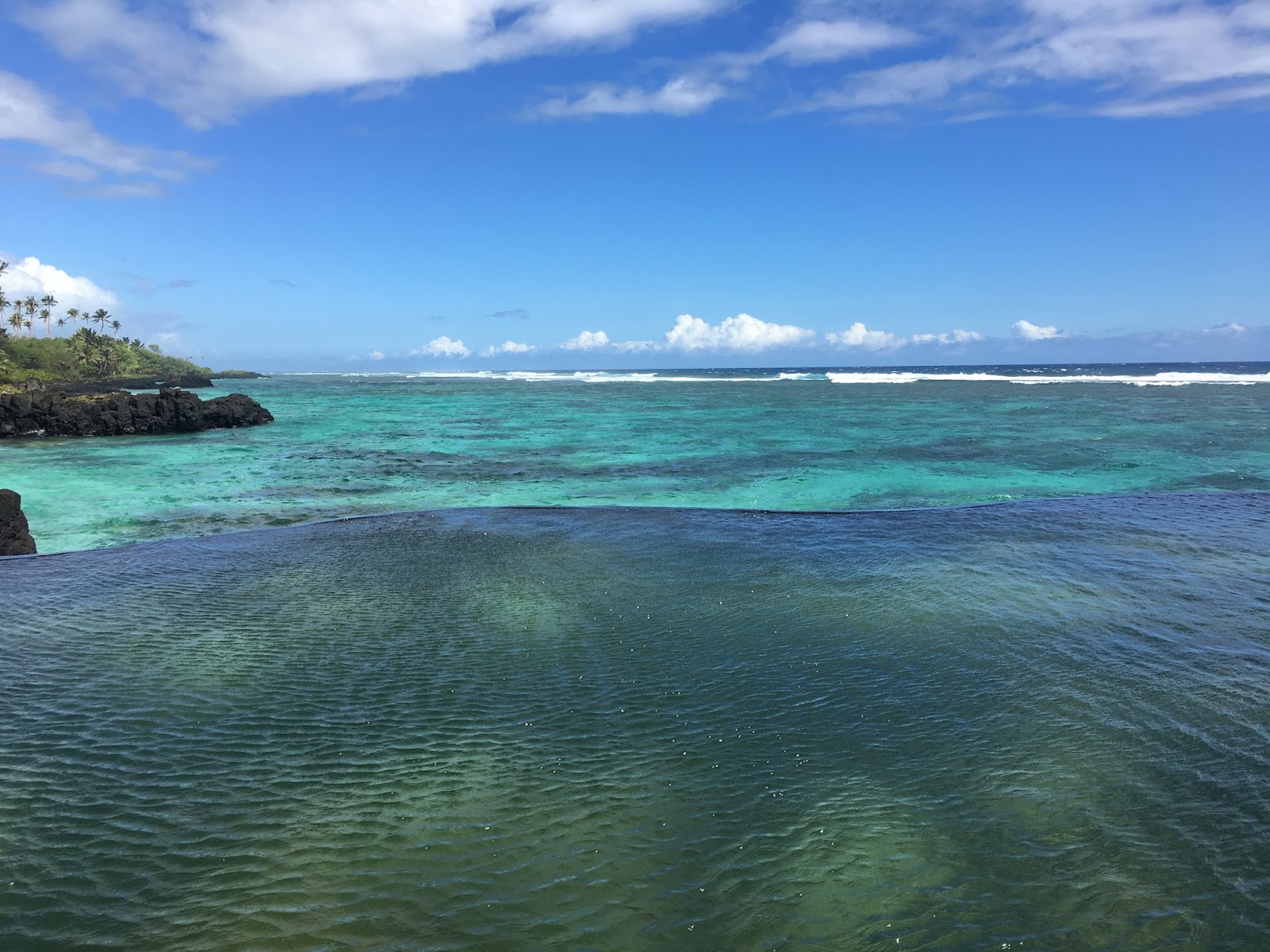
This is the view from the main headquarters.  Note the clearness of the water and the nearness of the reef.  For most of our stay the bungalows between us and the main headquarters were unoccupied, and there were only two other families staying at the opposite end of the resort.

Speaking of the rock wall and the outdoor shower, in all of our time in Samoa we experienced, between the two of us, a total of about 10 minutes of hot water.  When we arrived in our bungalow and tried the hot water we discovered that nothing came out from the tap or the shower.  The cold water worked great, but the hot was totally absent.  Naturally, we mentioned this to the manager right away, and she assured us that it would be fixed the next day.  Also, the in-room phones throughout the resort were not working.  The manager said that since the next bungalow was unoccupied we could use its shower and hot water.  I took advantage of this offer and walked next door to get clean.  About 5 minutes into my nice warm shower I heard a loud BANG!, and the hot water went away.  D'oh!  So I finished up with only cold water.  As I was heading back inside I noticed a stream of warm water running out from under the bungalow toward the outside drain, and the water was warm.  Apparently something had broken, and all of my wonderful hot water was draining away into oblivion.  After drying off and dressing I walked over to the headquarters and informed someone of the situation.  The next day our hot water was not fixed, so we decided, with the manager's blessing, to use the next-door shower that night.  About 5 minutes after turning on the hot water, BANG!, and the hot water went away again.  That was the last we saw of hot water in Samoa.  We told the manager about it again the next day and resigned ourselves to cold showers.  Part of the trouble was the timing: Christmas Eve, Christmas, Boxing Day, the weekend - all of these together meant that it was unlikely that a worker would come out to fix our hot water.

Despite this, I can heartily recommend the Sa'Moana Resort.  The staff is friendly, the food is good, and they even remember your name, which can be a bit weird at first.  At the restaurant I had the tallest hamburger I've had to date.

Those are banana fries, by the way.  They were okay, but needed salt.  The first couple of times I had the banana fries I salted them, and then suddenly they started coming to the table already salted.  Now that's good customer service.  We also had fish and chicken and a lot of mangos and fresh fruit.  Food service was a bit slow, but that seemed to be a common thing in Samoa.

On Christmas Day I continued what seems to have become a tradition with me - I had a rum drink.  This is not something I asked for; this was a free gift from Santa Claus (he visited the resort via kayak).  The kids at the resort got cookies and notepads, and the adults got a free rum drink.  Sadly, all I could taste was the alcohol, and that's not a pleasant taste.  I squeezed the pineapple wedge to get some of the juice inside the drink, and that helped a little.


The resort has kayaks and snorkeling gear to borrow, and it has an infinity pool in the midst of a crab habitat.  The crabs are small and harmless, but they do watch you when you swim in the pool.

The Sa'Moana has a tour guide, Tala, and he took us on a couple of day trips around the island.  And this leads us to a word about our adventures.

A Word About Our Adventures

Our first adventure was getting to the resort.  The roads on Samoa are maintained by the local villages, and there's no guarantee that any particular road will be in good shape.  The road through Salamumu Village is especially adventuresome, being composed of white sand over black volcanic rock, and it's the only way to and from the resort, so we got to experience it quite a bit.

Our first day trip started with a visit to the big market area in Apia, the capitol city on Christmas Eve.  The first things we bought were two big Cokes.  And I mean big.  750ml of Coca Cola goodness, in a glass bottle, sweetened with real sugar instead of corn syrup.  On a hot day wandering around the markets a big Coke is very refreshing, and it lasts a long time.

Markets aren't really our thing, so we didn't buy much - a sarong for Becky, a couple of t-shirts for me.  Our next stop was the Piula Cave pool, a freshwater pool mostly inside of a cave that runs beneath the Piula Methodist College.  The pool is very inviting and clear, and there's even a secret underwater passageway to an ajacent cave.

How could you possibly resist swimming in this water?  It was pretty awesome.  While there we met a family of five that had lost all of their luggage and had to buy new clothes.  They were travelling on Fiji Airlines, which loses a lot of luggage, according to Tala (our guide).
Speaking of Tala, here he is in the clear water.  The pool is not real deep, but it is refreshing and a lot of fun to be in.

After Piula we went somewhere for lunch, and then on to the Palolo Deep Marine Reserve and its deep blue hole.  Becky enjoyed the view of the ocean and the blue hole from the beach, but I donned flippers and mask (and snorkel) and went out to see the blue hole up close.

Palolo is a great place to snorkel, and I spent an hour just puttering around and exploring the blue hole.  The water was pretty clear and quite salty.  The hole is about 150 yards offshore, and it extends several hundred yards out into the reef.  I explored mostly the edges of the hole, and I only got to see a very small portion, but it was beautiful.  Sadly, modern camera technology cannot convey the full impact of seeing it up close.
Here's Tala again.

It's one thing to see the fishes behind glass, in an aquarium, but it's truly amazing to be in the water with them, with nothing separating you from them.


Our next day trip was on Boxing Day.  Our first stop was the world-famous To Sua Ocean Trench.  It's basically a big hole that leads down to a protected swimming hole that's connected to the ocean.

It turns out that there are actually two holes, this small hole, and the main big hole.
The two holes are connected by a cave tunnel.  The water rises and falls with the tide, and the depth varies as you swim around the hole.  The deepest spot when we visited was maybe seven feet deep, in the center of the pool.  We had a great time swimming in the pool and experiencing the beautiful grounds surrounding the holes.

This is part of the grounds surrounding the holes.  The proprietor of To Sua told us that when he visits New Zealand he looks at what plants do well there and he brings some back to To Sua.

After To Sua we stopped for lunch at Taufua Beach restaurant, where we had some good food and picked up more big Cokes.  Taufua Beach is the only really long stretch of sandy beach we saw on Samoa.  Most of the coastline we saw was either lava rock, or small beaches separated by lava rock.  I swam in the ocean at Taufua, and Becky enjoyed sunning on the beach.  It was nice to be able to be in the water and just swim, or float, and not have to worry about running into anyone or anything.

We made two more stops after Taufua - Sapoaga Falls and Togitogiga Waterfall.  Sapoaga Falls is a magnificent tall waterfall surrounded by lush green jungle.

As I was looking down the lush primal jungle valley, it dawned on me that this would be a great spot to see a tyrannosaurus come crashing out of the jungle.  For the record, I did not see a tyrannosaurus, but that doesn't mean there are none in the area.  The grounds around Sapoaga include some Samoan cultural artifacts, such as a cooking hut and log drums.  We also discovered the rare Samoan fern tree, which Becky had never heard of before.  There were also several chickens roaming around.

Togitogiga Waterfall turned out to be a local swimming hole with a waterfall and multiple pools to jump into and out of.  It was pretty crowded on Boxing day, so we didn't stay very long.

That about sums up our big outings, which leads to a word about kayaking.

A Word About Kayaking

On the days when we were not taking day trips we took some local trips via kayak.  Our first kayak adventure took us along the coast to a small beach surrounded by lava rock.

This beach looked like it had had no human visitors in a very very long time.  After our beach visit we cruised along the coast in the other direction.

There is a lot of coral and reef all along the coast, and at times our kayak was floating only inches above the coral (I'll admit that we did scrape the top of the coral a few times).

A couple of days later we took our second kayak adventure.  This time we slowed down and spent more time just looking at the reef and the fishies and the beautiful surroundings.

It was like being on top of a rather large aquarium, looking down on the fishies as they went about their daily routines.  As we were headed back toward the resort we encountered another couple sharing a kayak.  In their case the man was doing all of the work while the woman just enjoyed the view.  Not so with us - ours was a team kayaking effort.  Our two kayaking adventures took place on Christmas Day and the day after Boxing day.  And this leads us to a word about Samoan Christmas practices.


A Word About Samoan Christmas Practices

We don't really know what Samoans do on Christmas in their homes, but we know what they do at the Sa'Moana Resort.  Our Christmas experience actually began on the night of Christmas Eve, when the entire staff and guest population of the resort drove down the road to the local Methodist church for their Christmas Eve service (the entire guest population being about 10-12 people at the time).  We were told before-hand that part of the service would be put on by the youth of the church, and that there would also be awards given out for some type of agricultural/crop-growing contest.  We were told that our casual clothes were fine, but Becky should also wear a sarong and cover her shoulders.  The Samoans, on the other hand, were all dressed in their finest white clothing.  Some of the youth also wore bright green shirts.

As we were walking into the church and finding our seats in the back I recognized the music of the hymn that the people were singing, the hymn Praise The Lord.  They were singing it in Samoan, but the music was the same, so I very quietly sang the English words.  And boy can they sing!  The harmonies and melodies that we heard were magnificent.  For some reason I had assumed that the service would be in English.  After all, everyone at the resort, and everywhere else we went, spoke to us in English.  The only words of the entire service that we recognized were from the pastor,"We would like to welcome the guests of the Sa'Moana Hotel who are here with us tonight."  That's it!  We could tell from his varied voice inflections and changes in volume that the pastor was probably quite a dynamic speaker, but we can't be sure because we didn't understand a word he said.  And the congregation didn't give any kind of feedback - they all sat respectfully and listened attentively and quietly.

After the sermon the youth went up to the front and sang several songs, in Samoan, and they had wonderful voices.

After the singing came the lengthy awards giving-out.  Some trophies and gift baskets were brought to the front of the sanctuary and placed on a table and a man got up to speak.  What he said, I have no idea, but he spoke for quite a while.  We thought he was leading up to giving out the awards on the table, and he eventually said someone's name.  The first award give out was a piece of paper of some sort.  Then someone else spoke for several minutes (all of it in Samoan) and eventually another name and another piece of paper was awarded to a youth person.  It went on like this for a long time.  Someone talking in Samoan for several minutes and then finally another name and another paper award given.  We were hot, we had sweat running down our backs, we were sitting on hard wooden pews (with no lumbar support) with only the vaguest idea of what was going on, but what could we do?  We had to sit through the whole thing.  Eventually they did start reading off names en mass for the rest of the paper awards, and eventually the trophies and gift baskets were given out.

And then it was time for a cup of tea.  This consisted of everyone going outside into the less-warm night air and sitting on benches and chairs for a time of fellowship.  We guests from the resort were guided to benches on the steps of the church to sit with the pastor and the elders.  Plates of sweets and cakes and pies were placed in front of us, and large cups of a hot beverage were poured.  Becky insists that it was sweetened coffee, but I disagree.  Whatever it was, it was sweet and warm and delicious.  This hospitality made up for us having to sit through the giving out of the awards.

And then it was time for the fire dancing.

This is not something that they normally do on Christmas Eve, but to raise some funds and because we were tourists, some of the young men put on a demonstration of traditional Samoan fire dancing.  It was quite thrilling, and the oldest young man was quite good.  Then it was back to the resort for bed time.

Christmas day dawned.  For Christmas lunch the normal restaurant tables were set up as one big table, and a special meal of ham, made from some of the local pigs, was served.  As lunch was finishing up Santa Claus came paddling up to the shore in a kayak.

As you can see, he almost made it to shore before he tipped over and went into the drink.  Being in Samoa, Santa looked Samoan.  He didn't have the white hair, beard, or big belly.  And he didn't have any gifts in the kayak, thank goodness.  He had cleverly hidden his bag of gifts in a patch of bromeliads at the resort, and we had a fun time as he passed them out.  The kids got cookies and note pads, and the adults all got a free rum drink in a coconut (we each got our own coconuts - no sharing).  In the afternoon we took our first kayak adventure - described in more detail in a previous section.  And this leads us to a word about Samoan culture.

A Word About Samoan Culture

We were not able to sample the entire spectrum of Samoan culture, but we did observe parts of it.  For instance, the Samoan people are very religious, and the majority of them claim Christianity as their religion.  We saw Christian churches (mostly Methodist), Mormon temples, and Roman Catholic churches.  The Mormons seemed to have their own unique building style.  There is a huge Baha'i temple in Samoa, but we did not visit it.

Something else we observed was that in the villages the houses are on large plots of land, and there's a lot of space between neighbors.
Filling some of this space are the family fales.  Each house seemed to have at least one large family fale, the open building in the photo at left.  Many of the houses also had at least one tomb in the front yard area, as can be seen if you click to enlarge the photo.  These tombs ranged from simple rectangluar concrete tombs to ornately decorated concrete or rock step pyramids.  The tallest step pyramid I saw looked, from the car window, to be about 8 feet tall, composed of about 6 steps, constructed from shiny (or possibly painted) black volcanic rock.

We also saw some fire dancing, mentioned above.  The resort has a culture day on Thursdays, but because it fell on Christmas Eve we were not able to attend a culture night.

Roaming dogs are another part of Samoan life.  Tala explained that these dogs are the pets of the villages, and they didn't seem to be aggressive or threatening to us, but their roaming means that garbage has to be placed on raised platforms for collection, instead of at ground level like we do it here.  And that brings us to a word about the weather.

A Word About The Weather

The weather was warm and comfortable most of the time, warm and breezy sometimes, and hot a little bit of the time.  One constant was the high humidity.  Becky describes it as, "very humid."  Pages in books could become damp from just being out in the open.  It also rained a bit.  During one of our day trips, while we were on the other side of the island, the resort received heavy rain all day.  When we drove back through Salamumu we saw that the road's large sinkholes had become large lakes.  Tala was experienced at driving on this road, however, so we made it back to the resort safely.  It also rained heavily on our last day at the resort, as we waited there all day until our ride back to the airport in the evening.  This caused a little trouble for us as we played pool and darts to pass the time.  The pool/darts room has large windows that open wide, which is great for airflow, but not so great when you want to keep out the rain.  With the windows all closed it got too hot and stuffy, but if we opened them it got too wet and slippery.  Somehow we survived, and rediscovered just how bad we are at pool and darts.  And that leads us to a word about mobile phone and internet service.

A Word About Mobile Phone And Internet Service

Both of our mobile phones were set up for use in Samoa, but when we arrived in-country we discovered that we couldn't get any service.  The phones seemed to connect to the cellular networks just fine, but our calls and texts would not go through.  This wasn't a huge deal, but I was expecting a call from someone, and I had no way to check my voice mail.  The hotel had a wifi signal, but when we tried to connect it directed us to a logon screen where we could buy short-term wifi access.  I asked the hotel manager how to get on the wifi, and she said to use the BlueZone network.  When I asked her if the hotel had free wifi she looked at me as though I had asked where I could see a live tyrannosaurus on the island.  It seemed that the idea of free wifi was completely foreign to her.  After a couple of days Becky really needed to check her business email, so we decided to pay for access to the wifi, but the logon screen for the wifi did not let us pay for access, so we asked the other hotel manager about it, and he said that the logon screen never worked, but the resort had some wifi access cards we could buy.

We bought two 1-hour wifi cards, one of which you see in these two photos, and that was sufficient.  And no, you can't use the information in these photos to get on Samoan wifi in the future because the user and password expire 15 days after their first use.

We also found out eventually that the only way to use the cell networks in Samoa is to buy access cards.  It seems that Samoan phone plans are all pay-as-you-go, and not monthly like we're used to.  And there are no free wifi hotspots.  None of this would have been a problem if we had known about the situation before going to Samoa, but our Lonely Planet guidebook failed to mention this very important detail.  And this leads us to some final words.


Some Final Words

We had a great time in Samoa, and we enjoyed the hospitality and service at the Sa'Moana Resort (despite the lack of hot water).  Sitting on the veranda of your bungalow while reading a good book and sipping a big Coke is a great way to pass some time.  And finally, a word about movies.

A Word About Movies

Movies watched on this trip, in the resort, on planes, or in aiports, included, in no particular order:

Indiana Jones and the Last Crusade
Divergent
The Maze Runner #1 and #2
Red Tails
Inside Out
The Eagle Has Landed
Where Eagles Dare
Life of Pi
Ender's Game
Tron
Tron:Legacy
John Carter
How to Marry a Millionaire - the classic version with Marylin Monroe
Night at the Museum
Pixels

And I guess that's the last word for now.
   bIsh

Thursday, December 17, 2015

New House Blog: Episode LXXXVII - Trench Run

In the same way that Han Solo took a brief hiatus from consciousness when he was frozen in carbonite, so the New House Blog is about to take its annual winter hiatus, when we are frozen in near-freezing temperatures overnight and low-to-mid fifties during the day.  Before we take said hiatus, however, we have several topics to discuss - X-wing trenches, home-grown tea, a friendly spider, carpenter bees, and maybe more.

But first, a Project G.R.O.S.S.S. update - we are happy to report that by doing nothing new, and taking a passive approach to the slimy squirrel problem, we ended up with our biggest pear harvest to-date.  Of course, we can't really take credit for this, as we didn't really have a plan for this year.  However, the pear tree seems to have had a plan of its own.  It came down with a case of fire blight, as discussed in this Episode, and because of this there were only a very few pears, not enough to attract the slimy squirrels.  After we excised the fire blight the tree underwent a tremendous growth spurt and produced a respectable harvest of pears, only one or two of which were eaten by the slimy squirrels.  My theory is that the fire blight delayed the pear harvest long enough for the slimy squirrels to lose interest and move on to to other people's pear trees, and the late harvest threw off their timing.  The harvest is over now, but it produced a lot of very juicy, very sweet pears - most likely bartlett pears.

Trench Run Part One

I received a text from my parents (or maybe it was mentioned during a phone call) that mentioned that their house's rain gutters were leaky and not working right.  I figured I could handle some rain gutter installation, and the Trench Project began.  Off to the Parents' House (a regular guest house on the New House Blog) to examine the trench.

The trench from below.  It doesn't look so bad.
The trench from above.  That's no place for an X-wing!

The trench was made of plastic, and as such it proved to be quite susceptible to warping and bending from the sun and the seasons.

Before you can rebuild you must tear down, and that's what I did.  Here you can see the remnants of the old trench.


Carpenter Bees

Remember the carpenter bees from the previous Episode?  Well, a couple of them had made a burrow in an outdoor structural member, and we didn't want to just leave it open for them to return to next year, but we also didn't see any reason to evict them right away.  The hole was already there, and it was not large enough to compromise any structures, but it might get larger if they were to return and burrow out some new rooms.  Since the carpenter bees are our friends we waited until their pollinating season was over, and we allowed plenty of time for their offspring to have left home, and then we forcibly evicted them and plugged up their burrow.  And by "forcibly evicted," I mean that they ended up dead.

Here is their burrow.  Notice the waxy residue around and below the entrance.
In this close-up you can kind of see that the burrow was not a straight path. We plugged the hole with a custom-carved piece of wooden dowel and some Gorilla wood glue.


Trench Run Part Two

After disassembling the old trench it was time to plan and gather materials.  I was told that the house is 64' long (or about 78 metric feet), and I based my measurements on this, but it turned out that things didn't quite line up as measured (more on that later).  I chose to use galvanized instead of plastic because it will resist warping and bending.

Trench parts, and my 6' ladder.  This was the shorter of the two ladders involved, and its shortness proved to be a liability.
More trench parts, and tools.


With materials gathered it was time to plot and plan.  Using the previously-mentioned length of 64', I measured where I thought things should go.  Trenches, though they look level to the unaided eye, are installed with a gentle slope so that water will flow freely to the downspouts.  Based on information I looked up I planned the trench to have two sections - a 29' section sloping toward the rear downspout, and a 35' section sloping toward the front downspout - and where they joined would be the high point.  To mark the intended slope I enlisted the help of my mom and a chalk snap line that I bought just for this job.

The intended slope toward the front of the house, as marked by the red chalk line.
The intended slope toward the back of the house.


Tea Time

Becky got me some Zinger Hibiscus herbal tea seeds for my birthday, and she planted them in some lovely pots.  After a few months of the California sun they got big and sprouted a lot of flowers.

The instructions on the seed packet say to harvest the red calyxes after each blossom is done blooming, and then dry the calyxes and crush for use in tea.
This is the first calyx harvest.  As of this date the calyxes are drying and I am looking forward to my first cup of home-grown tea.


Trench Run Part Three

With everything measured and plotted it was time to start pre-assembly of the components.  I assembled the end piece assemblies and pre-installed the hanging brackets on the trench pieces.

Hanging brackets were attached every 24" along the entire trench run.  Also in this picture are my trusty DeWALT and the tall ladder.

After pre-assembly comes my favourite part of any such project - assembly, finally getting to see the plans and ideas physically take shape before my eyes.

The installation of the ceremonial first length of trench. This one was only 5' long, so I was able to hang it without any help.
Assembly of the trench started at the meeting point of the two slopes, and we worked out toward the ends of the house.


Friendly Spider

In the back yard, near our flowers we came upon the following spider.

He appears to be some variety of common garden spider, and since he wasn't interested in biting us we decided to leave him be so that he could eat some of the pesky insects that inhabit our yard.

Trench Run Part Four

Assembly continued, and for the 10' sections of trench I needed help to hold them in place while I bolted the hangers onto the house.  My mom helped out a lot with this, and I could not have done it without her help.  We used two ladders, the tall yellow ladder and my blue 6' ladder.  The plan was for me to climb the tall ladder and position and attach one end of the section to the adjacent section of trench while my mom was on the 6' ladder holing up the other end of the section.  This plan worked great for the first 10' section, so we assumed it would be smooth sailing for the rest of the house.

But it was not to be.  We quickly discovered that the ground around the house has a slight slope, and the 6' ladder was just too short for my mom to stand on and hold up the trench sections.  We eventually came up with the idea of using a section of the old plastic downspout as an extension of her arms.  She held the downspout, and the downspout supported the trench until I could get he bolts in.

It was a good idea, and it worked, but we had some rough moments involving dropping of things and sections not fitting together right.  Sections not fitting together right was probably the hardest thing to deal with.  The joint pieces that connect the sections are manufactured in such a way that it requires some bending and jiggling of pieces to convince them to join together.

As we got to the ends of the house we discovered that the sections of trench extended past where my measurements said they should extend.  Remember, my measurements were based on a house length of 64', and while the house is technically 64' long, the roof is not 64' long.  There is a bay window that sticks out of the front of the house, and this bay window is what makes the overall length of the house 64'.  Fortunately, this measurement discrepancy was easily resolved by my tin snips.

As you can see, this is a proper trench for an X-wing.


The trench as viewed from an X-wing's perspective.

After the trench was assembled and bolted on to the house it was time to install the downspouts.  Here you can see the view toward the rear of the house.  If you look closely you can see where the superfluous third downspout used to be.

And the view toward the front of the house.  The final step of this project was to seal up the trench joints with silicone caulk.

A big thanks to my mom.  I could not have done this project without her help.


Finishing Up

Finally, we finish this Episode with a new team member and a mystery photo.

Meet Sedgewick, our new step edger.  After continued disappointment with the build quality of our two previous wheel edgers (Reggie and Reginald) we decided try abandon wheel edgers and look for something a little more dependable.  So far results have been positive with Sedgewick.

We leave you with this mystery photo from under our house.  It looks like a fresh run of Cat 6, but for what purpose?


The force is strong in this
     bIsh

Wednesday, September 09, 2015

New House Blog: Episode LXXXVI - Pears, Pruning, Produce, Pests, And Portals

The New House Blog is back from summer vacation, and we've got a packed Episode for you today.  We'll start off with a pear update, move into a pruning project at the Parents' House, proceed to some pests, peruse a portal, and maybe throw in a cute cat picture.

Before we get to all of that, however, we have a brief 'hood update.  And it begins with this photo that I took on my way in to work one morning.  It's not exactly in our New House's local 'hood, but it is someone's 'hood.

While waiting for a light to turn green one morning I spotted this interesting individual, presumably on his way to work, too.
I'm guessing that the colorful decorations are mainly to increase his visibility so that cars are less likely to run him over.


There was an apartment fire just down the street from us recently.  I was made aware of it as I drove home from a local Fatburger, or maybe home from work.

The action was pretty much over when I drove by, but the other side of the street was blocked off for several blocks.
I believe that no one was seriously hurt, but there was some serious property damage.


We wrap up our 'hood update with this scene, viewed just 15 minutes away, by bike, from our New House.

What you don't see is the shopping cart just outside the right edge of the frame.


Pear Update

We harvested our first harvest of pears in July, as seen in the previous Episode. Those pears were joined by two more from the tree.  The first batch of 6 pears was left in the reefer for too long, resulting in wrinkly pears that tasted delicious but were not juicy or soft.  The two additional pears were left chilling for less time and they turned out to be both juicy and delicious.  We may have figured out the ripening formula for our pears.  And we have 6 or 7 new pears on the tree at this time.  So far the slimy squirrels haven't bothered our pear tree this year, but we're remaining vigilant, just in case.

Pruning

My dad recently asked for some help in pruning a tall evergreen tree, and I was happy to help.  I was so happy to help that I went out and bought a new tool just for this pruning job.  

Meet Pinchy.

Pinchy is a 60" (5-foot, or 6.1-metric foot) pruner, and I was able to accomplish some truly amazing pruning with Pinchy.  

Pinchy is one of those tools that you just love to use - that you want to just keep using long after the job is officially done.  I found myself looking for more branches to prune, even if they were not on the official pruning list.


Pinchy has since helped with pruning of our ever-growing oleanders.
As you can see, Pinchy and me (or is it Pinchy and I? They keep changing the rules) make a pretty good team.  Much of the pruned wood will end up in our fireplace.


Produce

We have been enjoying fresh produce from our food and pottery gardens.  Here is a picture of an intriguing potato.  Note the star pattern in the center.

We don't know what it means, but it must mean something.

We are still looking forward to enjoying our melons.  This Christmas melon is developing nicely.
As are these honeydews.
Note the fresh catnip near the little baby asian melon.


Cute Cat Interlude

As hinted at above, we have cute cat interlude, just because we can.

Here is an action shot of Edgar stretching his jaw muscles.
And here he is relaxed.


Pests

The particular pests in question are members of the spider family, possibly the same spider family.  If you are squeamish you may want to skip to the next section, as there will be several close-ups.  

>><<  Mactans montage ahead! You've been warned! >><<

We had not seen any black widows (latrodectus mactans) at all this calendar year, and then suddenly I found, and killed of course, the first widow of the season, of the entire year.  It was a dark night, and I was outside preparing to water the back yard trees (on a day other than a designated watering day, too) when I came upon the foul fiend.  She was...  But first things first, and all in order. The spider I first spotted is seen below.

It might not be clear in the picture, but this is a brown spider with a distinctive, roughly hourglass, mark on her abdomen. She's shaped like a black widow, but she's brown.  My first thought was that she might be one of the infamous brown widows (latrodectus geometricus).  My second thought was that she needed to die.  However, this latrodectus was more clever than some, and she ran away and hid before I could dispose of her.

Here you can see some distinctive markings on her abdomen as she flees in terror.  

I did a little research, and discovered two pertinent and important facts regarding this brown 'widow. Fact one:  brown widows are not known to be anywhere near our part of California.  Fact two: black widows are brown until they fully mature, and they have whitish markings on their abdomens while immature (okay, that's three facts).

Logically, I concluded that this freak of nature was a not-yet-fully-mature black widow.  She eluded me for a few nights, but I won: she is no more.

Not so clever was this fully mature black widow (Perhaps they get more complacent as they get older). This is how she looked just moments before being squished by falling brick.

Not far away was this other juvenile 'widow, just hanging out upside-down. She's dead, but I don't remember precisely how I dispatched her.  

This final latrodectus mactans was found on another night, in the front of the house near the hose hookup.  Here you can clearly see her distinctive white markings and brown base color.  

Now you know: black widows are not black until they are mature.  They do, however, have an hourglassish mark on their evil underbellies.

>><< End of mactans montage! >><<

Not Pests

To counter the pests above we also have some non-pests to share with you.

Seen patronizing our hedgerow sweetpeas was this big, black, beautiful carpenter bee.
Here is another beautiful, big, black carpenter bee.  They are good pollinators, and they are quite friendly.  We enjoy having them around.  

This is a friendly bumblebee sipping nectar from one of our poppies.  Note the yellow markings and the slightly smaller size of the bumblebee. Until recently I mistakenly thought that these two types of bees were all the same type - bumblebees.  It's on ly recently that I learned to distinguish between the two.  

Portals

Our New House came with a lot of door knobs - a lot of old-style gold-chrome door knobs.  We decided to upgrade them all - 9 in total.  Below you see the sequence for a typical door.  We took pictures of all 9 replacements, but we thought it would be really boring to post all of those pictures.  If you really want to see all 9 door knob replacements, contact me and I will gladly share the pictures with you.

Our 1/2 bath had a typical, old-style door knob.  Note that the screws are on the inside of the door, which could be a problem if someone ever got locked inside.
Typical door striker plate.
 Typical striker plate cutout, with an atypical artifact.  Buried below the striker plate was an ancient 1/2 striker plate.
Yes folks, the pre-Bishopians had left this 1/2 striker plate in the door jamb.
We are quite baffled as to why they would do this.  It's not like it's a hard thing to remove. Did it maybe have some religious or cultural meaning to them?
Typical replaced door striker plate.
Typical replaced door knob.  Note the more modern look, and the screws are on the outside of the door.

If you're interested, we have 9 slightly used golden door knobs for sale - cheap!

Flying Farewell

And finally, we bid you adieu with this friendly flying farewell.


The bees are buzzing in the trees to make some honey just for
    bIsh